30 June 2026 — Publication
Towards an EU-wide accessible reporting

The European Single Access Point (ESAP) is an EU-wide digital platform designed to centralise access to public financial and sustainability information from companies. The scope will include a broad range of entities such as listed entities, credit institutions, insurers, investment firms, audit firms, but also other entities and SMEs required to disclose information under various EU regulations and directives.
ESAP functions as a “two-step reporting system”: companies first submit required data to a national or EU-designated “collection body”, which then automatically transmits it via a single Application Programming Interface (API) to the central ESAP portal. While companies remain responsible for data accuracy, this system streamlines dissemination for investors and stakeholders.
Read about ESAP’s milestones and expected reporting requirements in our factsheet.
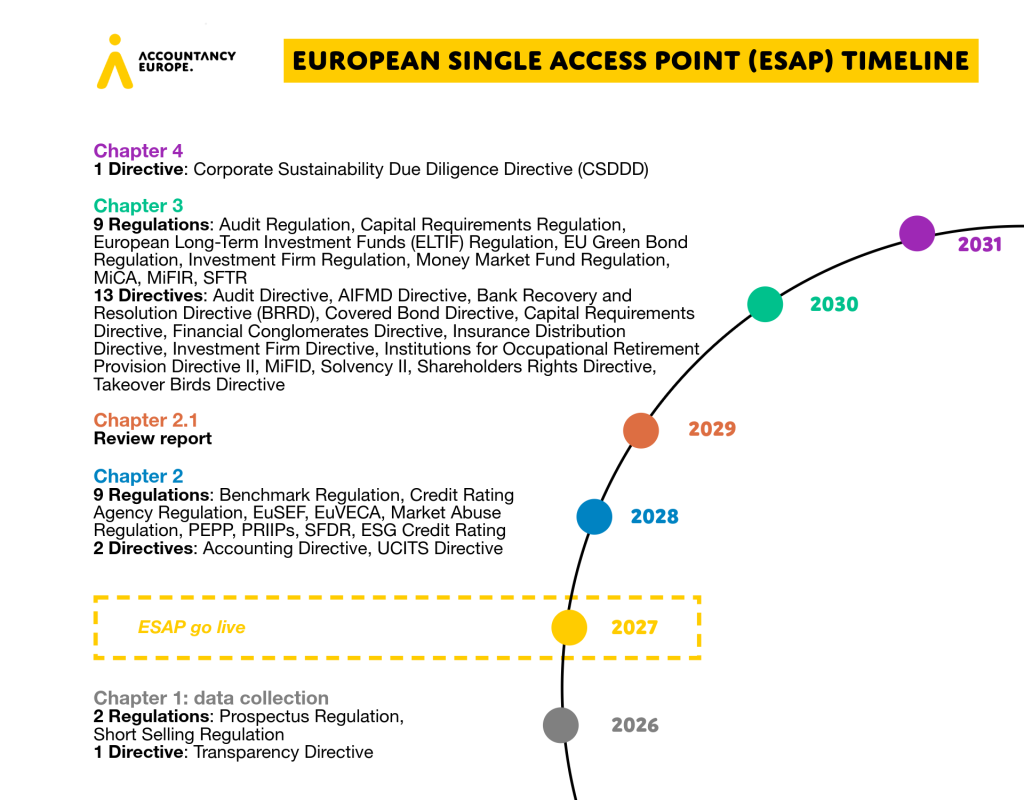
ESAP’s legislative framework was published in December 2023. The platform is mandated to go live by 10 July 2027, operated by the European Securities and Markets Authority (ESMA). Reporting requirements will be phased in: core financial and sustainability data under the Accounting and CSRD directives becomes accessible from January 2028. Audit-related transparency reports and sanctions follow from January 2030, with the Corporate Sustainability Due Diligence Directive (CSDDD) annual statements joining ESAP from 1 January 2031.
ESAP itself does not create new reports but centralises existing disclosures. The platform will provide free public access to:
To ensure data is extractable and analysable, submissions must be in specified digital formats. Machine-readable formats like XBRL (XML, inline XBRL) are mandated for structured data under CSRD, while data-extractable formats (e.g., PDF) may suffice for other documents. Critical metadata must accompany each submission, including the company’s Legal Entity Identifier (LEI), size category, industry sector, and document type.
National authorities or EU bodies act as collection bodies, validating submissions before API transfer to ESAP. They perform automated checks to reject non-compliant filings and assist companies. ESMA also validates data at the central level and enforces a robust IT security policy to guarantee information authenticity, integrity, and non-repudiation.
The accounting profession is pivotal in enhancing the reliability of ESAP data. Preparers must ensure disclosures comply with evolving digital taxonomy rules, particularly for sustainability reporting in XBRL under CSRD.
Entities must adapt processes for machine-readable reporting, manage LEI requirements, and engage with collection bodies to ensure seamless, high-quality data submission to this transformative EU platform.
Auditors of Public Interest Entities (PIEs) will ensure that their transparency reports will be accessible.