
Read the recap of our latest CSRD practice forum, fostering open exchanges on CSRD implementation together with ECG

Our paper examines how various actors within the corporate ecosystem can identify and mitigate greenwashing's risks
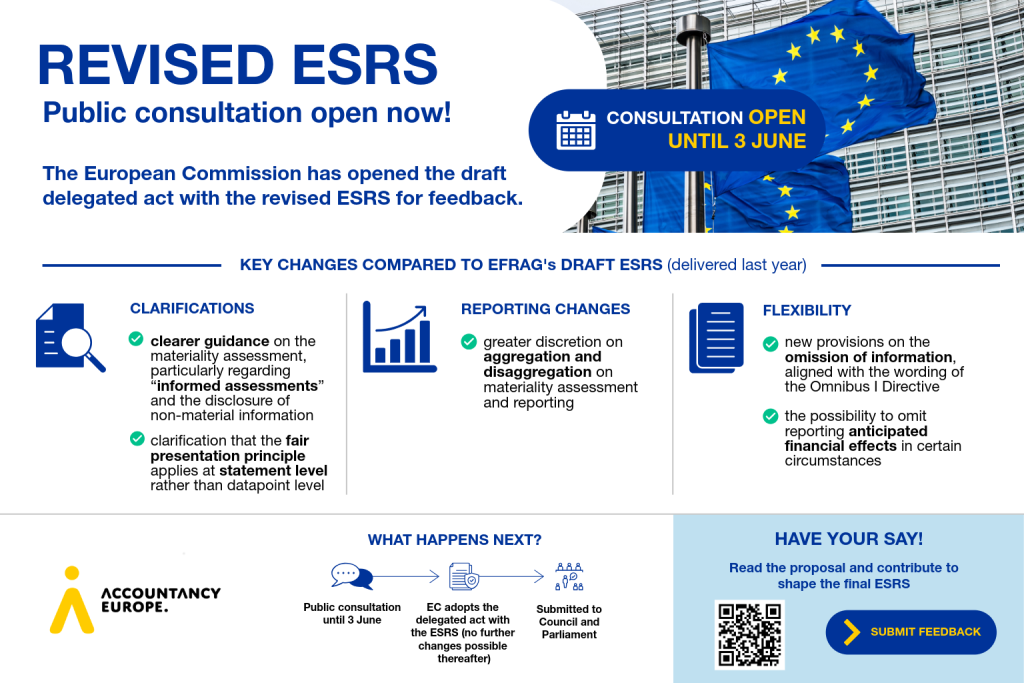
The European Commission (EC) has launched a one-month public consultation on the draft Delegated Act (DA) for the revised European Sustainability Reporting Standards (ESRS). Stakeholders can submit feedback until 3 June 2026.
Following EFRAG’s technical advice, the EC has introduced several major adjustments to simplify ESRS:
The EC also published a voluntary reporting standard for companies with fewer than 1000 employees, including SMEs. Although voluntary in nature, the standard carries legal bearing, as CSRD in‑scope companies cannot require value‑chain partners with fewer than 1000 employees to provide information beyond what is set out in this standard.
EFRAG submitted to the EC its 2026 work programme outlining the following key priorities:
The European Parliament’s (EP) Committee on Economic and Monetary Affairs (ECON) and Committee on the Environment, Climate and Food Safety (ENVI) held a joint meeting with the EC on the implementation and revision of the EU Taxonomy’s DAs.
The EC shared that:
Some MEPs raised concerns that the tight timeline might increase administrative burden and called for more ambitious simplification. While others highlighted that this revision is watering down the TSC rather than simplifying it.
The MEP Gerben-Jan Gerbrandy (Renew/The Netherlands) issued a draft report on the EC’s proposal to revise the Sustainable Finance Disclosures Regulation (SFDR). The report:
As next steps, the report will be presented to the ECON committee on 3 June, with amendments due by 4 June.
The EC has published a new package of measures aimed at simplifying the implementation of the EU Deforestation Regulation and easing compliance for operators.
The package includes a report, updated guidelines, FAQs and a draft delegated act adjusting the list of products covered. The EC estimates that the changes could reduce administrative costs by up to 75%.
The draft delegated act also proposes targeted revisions to the product scope, including the addition of certain downstream products such as soluble coffee and selected palm oil derivatives, alongside exclusions for items such as leather, retreated tyres, product samples, some packaging materials, second-hand goods and waste.
A public consultation on the draft is open until 1 June 2026. In parallel, the EC is upgrading its information system to streamline reporting, including simplified procedures for small operators and improved digital functionality.
The EC published a non-binding notice (FAQ) on the amendments to the Disclosures DA introduced by the Omnibus DA on the reporting of Taxonomy-eligible and Taxonomy-aligned economic activities.
The FAQs address questions raised by stakeholders, including reporting entities, supervisory authorities, and the Platform on Sustainable Finance (PSF).
The guide clarifies existing legal provisions without creating new obligations or rights. The objective is to:
The EC released two DAs complementing the ESG Ratings Regulation, which will start applying as from 2 July 2026. These acts provide technical details on how the European Securities and Markets Authority (ESMA) should apply its oversight power regarding fees and penalties.
The first DA outlines procedural rules governing ESMA’s power to impose fines and periodic penalties. It defines investigation protocols, infringement proceedings, and limitation periods for collection.
The second DA establishes a fee structure for rating providers:
Both DAs will undergo legislative scrutiny by the EP and Council before they come into force.
ESMA launched a public consultation on draft guidelines for endorsing non-EU ESG ratings providers.
The proposed guidelines clarify the specific information required for endorsing applications to ensure the process is proportionate and consistent. ESMA is seeking stakeholder feedback until May 29, 2026. A final decision on the guidelines is expected by late July 2026.
ESMA published a report with an overview of its enforcement activities on corporate reporting, including financial reporting, sustainability reporting, and ESEF. On sustainability reporting:
ESMA published its updated assessment framework for opinions on ESRS technical advice. It ensures that ESMA provides the EC with robust, consistent opinions in alignment with the Corporate Sustainability Reporting Directive (CSRD) and the 2026 Omnibus I revisions.
The OECD has published a report on trends and policy recommendations on sustainable bonds. It reveals that the sustainable bond market reached a combined corporate and official sector total of USD 4.6 trillion by the end of 2024. However, these bonds suffer from lower liquidity and a lack of consistent pricing benefit. The report provides five key recommendations to enhance market efficiency and investor protection: