Our event will bring together the European Commission, European Parliament, Member States, and practitioners. Register now to join us on 12 May.

Accountancy Europe strongly supports the Commission’s work in seeking to simplify and streamline European direct tax legislation. Read more in our response
The latest edition of the EU’s annual Tax Symposium, co-organised by the European Parliament (EP) and the European Commission (EC), took place on 16-17 March. The Symposium has become an important forum for policymakers, academics, businesses, civil society and practitioners to exchange views on the future of taxation. This year’s theme, “The future of taxation: inequality and growth in the global economy”, brought discussions on how tax systems can support fairness, competitiveness and sustainable growth.
The programme featured a wide range of perspectives, from ministers and EU policymakers to economists such as Joseph Stiglitz and Philippe Aghion, with discussions covering topics such as tax simplification, the role of taxation in the Savings and Investments Union, multilateral cooperation and ways to close tax gaps.
Accountancy Europe’s CEO Eelco van der Enden spoke on tackling tax gaps and strengthening revenue collection. He underlined the accountancy profession’s role in improving compliance, supporting well-functioning tax systems and helping policymakers design rules that work in practice. His message was simple: to use technology to develop robust cooperative compliance programmes that can help plug tax gaps whilst reducing burdens on tax administrations and authorities alike. Eelco also stressed that better coordination of EU tax systems serves every Member State’s national interest.
The EC presented on 18 March its proposal for EU Inc., a new single set of corporate rules, building the cornerstone and starting point for the EU’s 28th regime. EU Inc. is an optional, digital-by-default European corporate framework. It aims to make it easier for businesses to start, operate and grow across the EU, thus incentivising them to stay in Europe.
The proposed package of measures consists of the core regulation, an annex setting out the template/minimum requirements for articles of association, a recommendation for the definition of innovative start-ups and scaleups and a general Communication describing the proposal and explaining its policy choices.
Main features of the EU inc. proposal include the following:
Although the proposal does not contain strong tax harmonisation provisions as anticipated, the 28th regime might be complemented by additional proposals, including on tax, in the future. This was according to Mr. Kevin Barrett, Cabinet member of Commissioner McGrath who spoke at Accountancy Europe’s 13 April event.
The EP and the Council will form their positions on the proposal, before negotiating a compromise. Both the EC and Member States aim to finalise the proposal by the end of the year.
The EC launched on 18 March a public consultation on its planned EU e-invoicing reform, with potential legislative proposals to be expected for the end of 2026.
The objective of this initiative is to review the existing EU framework for e-invoicing, to increase harmonisation of e-invoicing rules across the EU, increase uniformity in the use of e-invoicing by EU businesses, including SMEs, and ensuring its consistent use in public procurement throughout the EU. The initiative also aims to enable businesses and other stakeholders to exploit the potential of e-invoicing, including in reusing of e-invoicing data to support automated reporting.
The deadline for responding to the consultation is 10 June. Accountancy Europe is currently gathering its experts’ input to prepare a potential response to the consultation.
The EC’s departments have published their annual Management Plans, detailing each Directorate-General’s (DG) priorities for the year.
DG TAXUD’s plan highlights that a proposal on VAT travel package is expected for the end of 2026, alongside efforts to reach agreement on BEFIT and HOT by year-end (though this remains unlikely, see article below). A consultation on the implementation of CBAM is also planned for Q2 2026.
The EC has released its latest tax revenue statistics for Europe, covering all EU Member States (including aggregates at EU-27 and euro area level), Iceland, and Norway.
In 2024 EU-27 countries collected €7.1 trillion in taxes, a 5.6% increase from 2023. However, strong nominal GDP growth (4.4% in 2024) partially offset this rise, leading to only a modest increase in the tax-to-GDP ratio from 39.0% in 2023 to 39.4% in 2024.
Denmark (45.2%), France (43.5%), and Austria (43.4%) had the highest tax burden in the EU-27, while Ireland (21.7%), Romania (27.9%), and Malta (28.8%) reported the lowest rates.
In terms of tax revenue composition in 2024, labour taxes (including social contributions) grew by 6.6% in nominal terms, driven by rising salaries and a strong labour market. Consumption taxes increased by 5.0%, whilst capital taxes saw slower growth (4.1%), largely due to stagnant property tax revenues. As a result, labour taxes now account for 51.5% of total EU-27 tax revenue (up from 51.1% in 2023), while the shares of consumption taxes (26.8%) and capital taxes (21.6%) declined slightly.
The EC has published a new study on the links between corporate taxation and investment. It looks at how tax reforms in EU Member States, particularly business taxation, can foster investment while maintaining public revenue in a context of high debt and significant fiscal need.
The paper finds that cuts to statutory tax rates are a costly way to boost investment. Targeted incentives for investment may be more cost-effective, but insufficient to counterbalance the static fiscal costs. Business taxation based on tax bases other than profits (e.g., on real estate or turnover) tend to be more distortive and harmful to investment than profit-based taxes.
The study also refers to specific aspects of the tax code that may open the way for aggressive tax planning (ATP), and argues that through the European Semester and reforms in national Recovery and Resilience Plans, the EU has achieved some success in fighting ATP in a number of countries, although some issues remain.
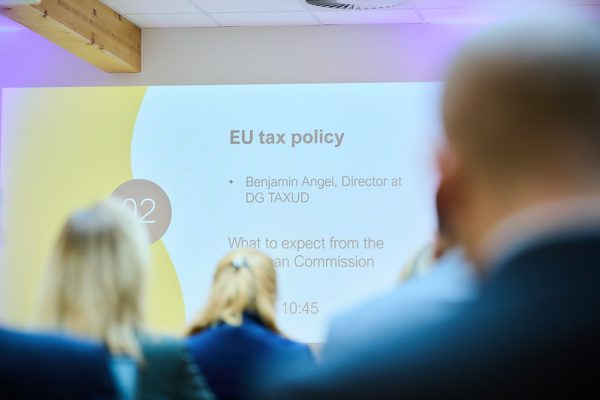
TaxNotes has published a podcast interview with DG TAXUD’s Director Benjamin Angel, and journalist Elodie Lamer asked him about different topical tax themes.
Angel notes that the Pillar 2 Directive will not be reviewed as part of the upcoming tax omnibus. He also indicates that the tax omnibus is expected to be published around 24-25 June, and is likely to be one of the most far reaching of all the omnibuses so far.
Angel also says that the EU dispute resolution mechanism will not be extended to Pillar 2, and that EC plans to extend the DAC to cover beneficial ownership of real estate. He adds that there are no intentions for the EC to review the public country by country reporting (CBCR) Directive, given its political sensitivities. Finally, Angel indicates that the pending BEFIT proposal may require revision before discussions on it resume.
The EC published on 15 April its long-anticipated study on wealth taxation, covering net wealth, capital and exit taxes. It aims to provide a better understanding of these taxes, their interrelation and consequences.
The study consists of two volumes: one reviewing academic literature in both EU and non-EU countries, and mapping the existing wealth-related tax regimes in EU Member States.
This helps to identify areas of consensus in the research as well as areas which require additional analysis to better understand the consequences of certain taxes. For example, while there is some evidence of the effects of net wealth taxes and inheritance and gift taxes on intranational mobility of individuals, there is limited evidence with regards to international mobility of ultra-high-net-worth individuals.
The second volume is structured around case studies from countries which currently have or have had a wealth tax, to better understand the overall implications of these. The study includes an in-depth analysis of four Member States (Austria, France, Germany, Spain) and three non- EU countries (Norway, Switzerland, Colombia).
The analysis shows how the outcome of these taxes, both in terms of revenue and in promoting both horizontal and vertical equity, is strongly influenced by tax design and taxpayers’ responses. In practice, the wealth taxes have not been a major source of revenue, and the study points to tax gaps, stemming from tax reliefs, exemptions or inadequate compliance, as an explanatory factor. Periodical publication of tax gaps may incentivise voluntary compliances.
The EP’s S&D Group has sent a letter to European Commissioner Wopke Hoekstra demanding clarification of the economic losses resulting from the deal brokered with US President Donald Trump in January, which exempts American multinationals from key parts of the landmark global agreement on a minimum effective corporate tax rate of 15%, agreed in 2021.
MEP Ľudovít Ódor (RE/Slovakia) has published his draft report on the feasibility of a 28th tax regime and its potential to support EU competitiveness.
In this non-binding draft report, MEP Ódor outlines options on how to overcome tax obstacles for 28th regime entities, by proposing the possible design of a 28th tax regime for a particular subset of, or eventually, all companies.
This tax regime consists notably of coordinated tax incentives, a harmonised capital gains treatment and automatic double taxation relief, safe harbours to routine intra-group services and low-risk transactions, and taxation of employee stock option treated as capital income rather than employment income.
The ECON Committee is expected to vote on the draft report in June, followed by a final Plenary vote on 6 July.
In October 2025, the EP, under the leadership of MEP Michalis Hadjipantela (EPP/Cyprus), proposed a number of recommendations to the EC to simplify EU tax legislation. Accountancy Europe was proud to support Hadjipantela’s and his MEP colleagues’ work on this file.
As is customary, the EC has now responded, outlining planned follow-up measures. These include greater cooperation between Member States and national tax administrations, to enable a more consistent interpretation and application of direct and indirect EU tax legislation, including through non-binding EU guidance.
The EC is also working with EU tax administrations to enhance their digital capabilities, and is advancing the cooperative compliance pilot project to strengthen cooperation between taxpayers and authorities.
The EC acknowledge MEPs’ call to simplify the VAT system, noting that a study on “VAT beyond ViDA” will assess further steps for the EU VAT acquis. It also confirmed that it is exploring ways to green VAT, including a review of the second-hand scheme, and will prepare a Recommendation the eliminate tax obstacles for remote cross-border work and employees relocations.
On 16 April, the FISC Committee debated proposed amendments to the draft report on financial sector taxation (see the February Tax Policy Update for details), prepared by MEP Matthias Ecke (S&D/Germany).
During the hearing, he stressed that the current system is inefficient and fails to stimulate growth, calling for convergence, reduced administrative burdens, and greater legal certainty, while respecting Member State tax competences.
MEP Luděk Niedermayer (EPP/Czechia) emphasised that Europe’s problem is not taxation but a lack of investment. He warned against major VAT changes that could increase costs and opposed new EU taxes or a revival of the Financial Transaction Tax (FTT).
Across the debate, MEPs were divided between those seeking cautious technical improvements and those pushing for broader tax reform, with strong disagreement over the role of the FTT and how far EU-level action should go. The report is currently scheduled for a Plenary vote in June.
At the hearing on the 28th tax regime draft report (see article above), the lead MEP on the file, Mr L’udovít Ódor (RE/Slovakia), stressed that improving EU competitiveness requires tackling fragmented tax and legal systems, while keeping proposals politically feasible through a narrower, possibly optional, 28th regime. MEP Luděk Niedermayer (EPP/Czechia) noted that the 28th regime could be applied only to young, innovative companies, as this would be more politically acceptable to the Member States, but added that this would also require the design of an exit system. Bruno Gonçalves (S&D/Portugal), for his part, noted that while full tax harmonisation would be ideal, the 28th regime could be a step forward in this direction. The ECON Committee will vote on the report on 3 June 2026.
On the same day, the FISC Committee also heard a presentation of a new study on the “Feasibility of a 28th tax regime in supporting EU competitiveness”. Professor Filip Debelva of the University of Leuven argued that an optional, targeted regime could reduce burdens without harmonising tax rates, using tools such as enhanced cooperation or opt-in directives. He emphasised flexibility, noting that reforms can be introduced gradually rather than as an all-or-nothing system. Anne Mieke Vandekerkhove, also from the University of Leuven, proposed a modular “building-blocks” approach with practical measures such as withholding tax simplification, R&D incentives, and loss relief. Her focus was on reducing complexity while respecting legal constraints and avoiding negative impacts on Member State revenues.
MEPs broadly agreed that tax fragmentation remains a key barrier to scaling businesses across the EU Single Market. Some supported the 28th regime as a pragmatic, optional step forward, while others questioned its ambition or warned against overreach into national tax competences. Concerns were raised about political feasibility, including limiting the scope, for example to innovative firms, and ensuring safeguards such as clear eligibility and exit rules.
Finance ministers from Austria, Germany, Spain, Portugal and Italy have sent a letter to the EC calling for measures to tax the windfall profits of energy companies in light of the ongoing Middle East crisis.
The Member States compare this to the 2022 temporary solidarity contribution established by Regulation (EU) 2022/1854 as an emergency intervention to address high energy prices at that time.
They called for an EU-wide contribution instrument “grounded on a solid legal basis” in order to address high energy prices.
At an 8 April EP ECON Committee hearing, Commissioner Dombrovskis confirmed the EC is assessing a more coordinated EU-level approach.