Our new analysis explores market developments from January 2025 to April 2026, identifying trends shaping private equity’s future in European accountancy

Subscribe to receive updates on audit and assurance, sustainability, tax, and SMEs
Welcome back from your summer breaks! I’m thrilled to be back with an autumn filled with tax news and developments, and to continue sharing them with you.
The coming months will hold much for EU tax policy enthusiasts to follow: progress (or not) on the Commission’s tax simplification proposals, EU negotiations on its long-term budget and possible new own-resources, VAT developments, whether on circular economy, travel and tourism or financial services, the evolution of global multilateral tax negotiations, and much more.
I’ll do my best to keep you up to date on these fast (and sometimes slow) evolving developments amid your busy period, so stay tuned. Also feel free to get in touch if you have any tax news tips.
With warmest regards,
Johan
The European Commission’s (EC) latest Annual Report on Taxation (ART) highlights how taxation is increasingly being used not only to raise revenue but also to support competitiveness, investment, decarbonisation and tax compliance across the EU.
Despite a weaker economic outlook marked by lower growth and renewed inflationary pressures, EU tax revenues remained resilient. The overall tax-to-GDP ratio increased to 39.4% in 2024 and is projected to reach 40.1% by 2026. Growth in revenue was driven primarily by personal income taxes and social contributions, reinforcing the continued importance of labour taxation in Member States’ revenue strategies.
The report identifies a longer-term shift in the tax mix away from consumption taxes and towards capital taxation, supported by strong corporate income tax (CIT) receipts. At the same time, environmental and property tax revenues continue to decline, raising questions about the sustainability of future revenue sources.
A key area of focus for the EU is the Clean Industrial Deal, with the EC promoting targeted tax incentives like accelerated depreciation and tax credits to spur investment in clean technologies. The report concludes that expenditure-based incentives are generally more effective than reduced tax rates.
Finally, the study shows that tax compliance depends on enforcement, simplicity, fairness and trust. EU citizens rank combating tax avoidance and evasion as the top tax priority.
The EC’s Electrification Action Plan aims to make Europe the first electro-powered continent by supporting clean transition and industry.
It seeks to narrow electricity-fossil fuel price gaps and accelerate uptake of heat pumps, electric vehicles and batteries, among others, while creating a more level playing field between electricity and gas. The EC notes that electricity-gas price differentials can discourage cleaner technologies.
The proposal to future-proof electricity bills will allow Member States to reduce network charges for certain consumers and taxes for energy-intensive businesses, while ensuring electricity is not taxed more heavily than gas.
Despite these tax elements, these pieces of legislation will follow the EU co-decision procedure, requiring European Parliament (EP) involvement and qualified-majority approval by Member States. This is because the tax provisions are specific and secondary to the proposals’ main objectives.
The EC is reportedly considering scaling back a proposed tax on large businesses designed to raise money for the EU’s next seven-year budget, according to four EU officials familiar with the discussion.
To overcome resistance from national capitals, the EC may reduce the number of companies covered by the new levy. It is considering exempting less profitable firms and raising the eligibility threshold to exclude SMEs.
Critics argue these changes will not be enough to facilitate an agreement. “Is it worth the trouble?” said a European diplomat familiar with German Chancellor Friedrich Merz’s thinking, referring to the EC’s mooted plans. They pointed out that more exemptions would lead to less income, without resolving the underlying problems of the proposed levy.
The development forms part of the ongoing negotiations on the next EU multiannual budget, including discussions on additional ‘own resources’. Further developments on the various own resource options under consideration are discussed below.
New figures show continued growth in businesses’ use of simplified VAT rules for online sales. Five years after the EU’s VAT e-commerce rules entered into force, VAT declared through the One Stop Shop (OSS) and Import One Stop Shop (IOSS) schemes continues to increase.
Since the VAT e-commerce package took effect on 1 July 2021, Member States have collected more than EUR 125 billion in VAT revenue through the schemes.
In 2025 alone, VAT revenue exceeded EUR 38 billion, up 17% from 2024.
Uptake has also grown, with more than 193,000 businesses registered by the end of 2025 to account for VAT on online sales through the EU’s simplified VAT schemes.
The consultation, launched on 9 September with a 4 November deadline, seeks stakeholder views on whether current EU VAT rules support the circular economy and how they could better promote circularity while benefiting businesses.
Accountancy Europe is consulting its VAT experts to help develop a response. The consultation is expected to inform a possible EC legislative proposal in the second quarter of 2027.
Financial institutions must record account holders’ names, addresses and, where applicable, Tax Identification Numbers (TINs) assigned by the EU country of residence. Under the Savings Directive, they must annually report TINs and other personal and income details to the tax authorities of the country where they are established.
TIN specifications, including structure and syntax, are determined nationally, with some countries using a different TIN structure for different categories of individuals (e.g. nationals and foreign residents).
TAXUD commissioned and published a study on “Taxpayer identification numbers (TINs) and possible verification instruments”, finalised in September 2026. The study identifies key lessons learned and challenges ahead.
The EP’s research services published a briefing paper on the EC’s taxation omnibus proposal.
The paper’s purpose is to provide information about the initiative to MEPs, and summarises the key provisions and objectives of the EC proposal. It also includes references to stakeholders’ positions, singling out Accountancy Europe’s June statement, along with those of Business Europe and Invest Europe.
The EP’s FISC Committee held two public hearings focusing on 14 July on the DAC recast and tax omnibus proposals.
The DAC hearing examined whether the proposal’s objectives can be achieved without compromising the fight against tax evasion and avoidance.
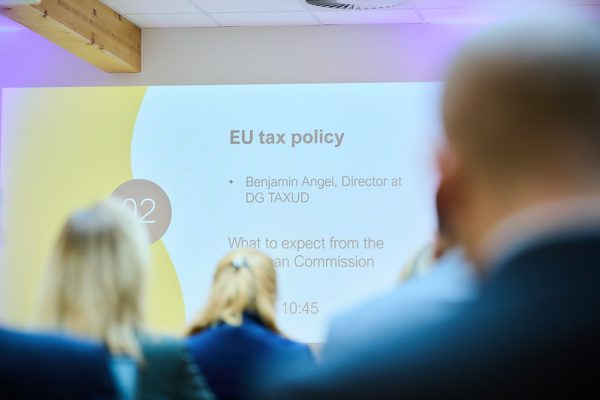
DG TAXUD Director Benjamin Angel said the DAC recast will simplify and consolidate the framework while improving tax transparency through better data quality, TIN validation and real estate beneficial ownership information, alongside reduced reporting burdens. He argued that the reforms strike a proportionate balance between tackling tax avoidance and cutting compliance costs.
OECD and academic experts broadly welcomed the proposal’s alignment with international standards and simplification measures. The Tax Justice Network, however, warned that exempting Pillar II companies from parts of DAC 6 could weaken oversight of aggressive tax planning and called for further analysis of revenue impact.
MEPs supported simplification but questioned its impact on tax evasion, information quality and use, and the Pillar II companies’ exemption from DAC 6. They called for stronger data sharing, consistent implementation, less administrative burden and clearer evidence of increased tax compliance.
At the hearing on the tax omnibus, the EC and business representatives argued that applying both controlled foreign corporation (CFC) rules and Pillar 2 creates unnecessary compliance costs and may lead to double taxation.
Tax Justice Network’s Alison Schultz warned that removing CFC safeguards could facilitate profit-shifting and benefit aggressive US-headquartered multinationals. She rejected characterising anti-avoidance rules as unnecessary red tape, arguing that their complexity reflects sophisticated tax-avoidance practices. Schultz also advocated for unitary taxation with formulary apportionment as a more systemic solution.
Business representatives and supportive MEPs criticised the implementation timetable, with some measures taking effect only between 2032 and 2037. Benjamin Angel attributed delays to Member States’ short-term revenue concerns, planning needs and the unanimity requirement. He also stressed that this was the first Omnibus accompanied by a systematic impact assessment and said its overall revenue effect should be neutral once wider economic benefits are considered. Schultz questioned the assessment’s methodology and perceived political bias, while several MEPs called for clearer estimates of the consequences for national tax revenues.
MEPs differed over the package’s ambition. MEP Fernando Navarrete Rojas (EPP/Spain) supported it but called for faster, broader simplification, while Matthias Ecke (S&D/Germany) questioned whether aligning CFC and Pillar 2 could weaken fraud prevention and sought greater clarity on revenue implications.
On 7 September, the FISC Committee held a public hearing, “Taxation trends in EU Member States: how tax policy or tax compliance can be improved?”. The EC presented its Annual Taxation Report, reviewing taxation and tax-related trends across Member States. Discussions focused on tax design, incentives and policy goals, and whether tax systems are fair, simple, and resilient while addressing market failures and promoting economic activity.
The EC highlighted continued reliance on labour taxation and argued that competitiveness should focus on “taxing better” rather than simply taxing less, with simplification and stronger compliance as priorities.
Michael Jäger of the Taxpayers Association of Europe stressed that compliance cannot be improved through audits and penalties alone, calling for simpler, more predictable tax rules, particularly for SMEs, while warning against excessive tax pressure and emphasising fairness and data protection.
Pascal Saint-Amans of Bruegel argued that EU tax policy is shifting from combating evasion towards competitiveness and growth. He called for better coordination on tax incentives, capital taxation and Pillar II, while stressing that simplification should not become an excuse for tax cuts and that digitalisation and AI create new tax challenges.
MEPs focused on labour taxation, wealth and capital taxation, and questioned the tax omnibus’ impact on avoidance, digital multinationals, SMEs and fairness.
On 7 September, EU lawmakers held a joint public hearing on how organised crime exploits weaknesses in the Single Market to commit VAT and customs fraud. The hearing brought together the EP’s CONT, IMCO and FISC Committees with experts and public authorities discussing the effectiveness of current EU rules, enforcement gaps and possible improvements.
Professor Marie Lamensch recognised the importance of detection and prosecution and called for an urgent review of rules associated with persistent, large-scale fraud.
DG TAXUD Klemen Oven noted that fragmented national systems create opportunities for fraudsters, leaving too many vulnerabilities across Europe.
European Anti-Fraud Office’s (OLAF) Pablo Tedo Murua stressed the need for closer cooperation between Member States and EU bodies to tackle fraud effectively.
On customs fraud, Dutch customs official Frank Heijmann highlighted changing trade flows dynamics, and emphasised the importance of carrying out EU customs reform. Supporting such a reform, MEP Dirk Gotink (EPP/Netherlands) welcomed plans for agencies such as the EPPO to have access to the EU customs data hub in the future.
The EP’s ECON Committee adopted recommendations on 10 September on the EU’s approach to corporate tax policy amid global developments.
Drafted by MEP Kinga Kollár (EPP/Hungary), the report focuses on the recent ‘Side-by-Side system’ (SbS) agreement, designed to ensure a co-existence of the OECD Pillar 2 and the US Net CFC Tested Income (NCTI) tax rule. It also addresses corporate tax fragmentation and simplification, international digital taxation negotiations and the UN Framework Convention on International Tax Cooperation. The legally non-binding report was adopted with 32 votes in favour, 4 against and 14 abstentions. A final EP Plenary vote is expected on 5 October.
Four MEPs of the FISC Committee recently visited Washington DC and Delaware. At the end of the delegation, Luděk Niedermayer (EPP/Czechia) highlighted discussions on the Side-by-Side system, including the need to simplify rules, ensure a level playing field between US and EU companies, and preserve the system’s robustness.
Niedermayer welcomed the agreement’s opening of dialogue on Pillar One and taxation of the digital economy, including digital taxation. However, he underlined that words must be followed by action and that negotiations should deliver an efficient and broadly acceptable system.
“Unfortunately, in our view, the US is lagging behind in matters of transparency and, at times, even moving backwards”, Niedermayer also stated. “The exchange of information under FATCA remains one-sided and the recent decision to remove beneficial ownership reporting requirements under the Corporate Transparency Act (CTA) for domestic companies has been a significant setback.”
He pointed to Delaware where, on the one hand, a very effective system of corporate law from the point of view of companies is in place, allowing access to predictable and consistent decisions. On the other hand, the MEPs also saw the opacity and anonymity used by shell companies registered in that state.
The EC, EP and many Member States support a large EU budget, while Germany and others seek major cuts. A key debate concerns own resources.
Council President Antonio Costa has made identifying new own resources acceptable to Member States a priority, suggesting that a budget deal may not be possible without new EU taxes. Ireland’s Prime Minister, whose country currently holds the rotating Council Presidency, has echoed this view.
After extensive consultations, Costa concluded that new EU taxes should target areas not currently levied at a national level. In the meanwhile, groups of Member States have explored specific ideas such as taxing oil companies’ “excess profits”, but until recently this idea did not gain traction. Now, however, they have asked the EC to present “further thoughts” on energy companies’ windfall taxation by early October.
Other ideas include a pan-European digital tax, but Commissioner Wopke Hoekstra has recently expressed his opposition.
The coming weeks and months will show whether Member States can agree on any of the proposed pan-EU taxes. The issue is becoming a pivotal component in the complicated budgetary negotiations.
Member State representatives have submitted initial observations and questions on the EC’s proposed tax omnibus, providing an early indication of key areas of debate.
A recurring concern is that measures such as proposed changes to the Parent-Subsidiary (PSD) and Interest and Royalties Directives (IRD) go beyond simplification and could substantially alter the allocation of taxing rights. The removal of minimum holding requirements and broader withholding tax exemptions are attracting particular attention. Germany describes the proposed changes to source taxation as “fundamental”, while Portugal argues they would significantly shift the balance between source and residence taxation.
Member States also question the shift from ex ante verification to taxpayer self-assessment and ex post controls. Belgium, Portugal and others ask whether tax administrations would retain sufficient tools to identify abuse, particularly regarding beneficial ownership and other anti-abuse considerations before payments are made.
Another key concern is the proposal’s fiscal consequences. France, Czechia, Poland and Portugal, among others, call for more granular analysis of the impact on individual Member States and national tax revenues.
Positions are expected to evolve in the coming months. The Council aims to reach unanimous agreement on the tax omnibus by the end of 2027.
See: Member States comments and more, and the EC presentation to the Council.
The OECD analyses a hypothetical scenario in which the global minimum tax (GMT) was not implemented and identifies several expected impacts of the framework.
Under the current GMT, average jurisdiction-level effective tax rates are estimated to rise by 2.8–3.7%, and by 5.5–6.9% in investment hubs. Effective tax rate differentials between jurisdictions could decline by 19–25%, potentially improving capital allocation. The GMT is estimated to reduce profit-shifting by 22.6–44.6%, while global corporate tax revenues are estimated to rise by 3.2–5.4% per year. Finally, the analysis highlights that initial 2024 post-implementation data indicates positive effective tax rate impacts of the GMT and no evidence of negative effects on investment or employment.
The OECD is reportedly developing a framework that could reduce the number of audits of multinational enterprises for Pillar Two compliance. Rather than reducing scrutiny, the approach would rely more on companies’ internal controls, transparency and information shared with tax authorities.
This would support cooperative compliance, based on mutual trust, transparency and ongoing engagement between taxpayers and tax administrations, rather than relying primarily on traditional enforcement and audits. Companies could voluntarily provide evidence of compliance, including third-party audit information, while tax authorities would use a risk-based approach to determine where further scrutiny is needed.
The approach is particularly relevant to Pillar Two, where complex rules and differences in interpretation across jurisdictions can create compliance costs and disputes. Better coordination and risk assessment could benefit taxpayers and tax administrations, while helping ensure governments receive the tax due.
Cooperative compliance programmes are also expanding beyond traditional early adopters, including Brazil’s CONFIA programme and Zambia’s initiative. These examples illustrate how transparency and dialogue can support compliance and trust.
The OECD initiative could therefore promote a more modern tax administration model, focused less on auditing everyone and more on understanding risk, rewarding transparency and building tax certainty through cooperation.
Bruegel has published a Policy Brief examining the links between profit shifting, tax harmonisation and investment, arguing these are becoming increasingly interconnected.
Bruegel considers the EU’s implementation of global anti-tax avoidance rules and the global minimum tax as a success, as they have substantially reduced profit shifting opportunities and strengthened revenue protection. However, it argues that this success has an underappreciated implication: profit shifting partly arose in response to differences between national corporate tax systems, allowing multinational firms to reduce the effective tax burden of investing in higher-tax EU countries. It thus both eroded tax bases and offset the influence of tax differences on real investment decisions. By constraining this form of ‘self-help’ while leaving the underlying diversity of national corporate tax systems largely intact, anti-avoidance reforms may make investments more sensitive to tax differences across the EU. Evidence shows that investment has become significantly more responsive to effective corporate tax rates in the last decade since coordinated anti-avoidance rules started to be discussed.
Reforms to tackle profit shifting have thus shifted the trade-off facing European policymakers to a trilemma involving tax sovereignty, revenue protection and investment neutrality. In this context, the success of anti-avoidance reforms strengthens the economic case for further coordination of corporate taxation within the single market, as anti-avoidance policy and tax harmonisation become increasingly complementary.
Apple paid Ireland $17 billion in taxes last year, representing 40% of its worldwide total, according to filings that offer new insight into the iPhone maker’s global tax liabilities.
The $17 billion payment was significantly boosted after the EU’s top court in 2024 ordered Apple to pay €13 billion in back taxes. The court ruled that Ireland had granted the tech giant “unlawful aid”, resulting in a tax rate of less than 1%. Apple paid $43 billion in corporate income taxes worldwide last year.
Ireland has reaped big windfalls due to its low corporate tax rate, which is 12.5% at present. In 2024, just three companies, widely believed to be Eli Lilly, Apple and Microsoft, paid almost half of all corporation tax collected in the country.
IMF
Working paper: Taxing cross-border services
Council
Member States adopt regulation amending rules on VAT fraud, granting EU anti-fraud bodies access to VAT information
OECD
Corporate Tax Statistics 2026
Rzeczpospolita
Polish government proposes national digital tax
European Commission
Eurostat publishes latest environmental tax statistics
European Parliament
FISC holds hearing on VAT reverse charge mechanism with final Plenary vote on 11 November
Agence Europe
Five suspects arrested in Czech Republic as part of European Public Prosecutor’s Office investigation into €20 million VAT fraud
OECD
Public consultation on taxation: Revisions to Chapter VII of the OECD Transfer Pricing Guidelines
OECD
Tax Policy Reforms 2026
European Commission
Arrangements for EUR 2 customs handling fee
Council
Poland’s Cezary Krysiak elected Chair of EU Council’s Code of Conduct Group on Business Taxation