Join us on 24 February for a MEPs-chaired discussion with Commissioner Albuquerque. Register now and find out more about the programme!

Accountancy Europe responded to the EC public consultation on the Directive for Administrative Cooperation in Direct Taxation (DAC). Read more
The European Commission (EC) published on 16 January a Delegated Regulation that supplements the EU Directive on faster and safer relief of excess withholding taxes (FASTER), by establishing Regulatory Technical Standards (RTS) for calculating market capitalisation and the market capitalisation ratio of Member States. These metrics are intended to determine when the common withholding tax relief procedures under the FASTER Directive apply and when Member States with efficient relief systems and smaller capital markets may be exempt from certain requirements.
The RTS, developed by ESMA based on MiFIR transaction data, define how to compute total market capitalisation (aggregate value of publicly traded shares) and the relative market capitalisation ratio versus the EU total. The standardised methodologies aim to ensure consistency and comparability across Member States.
The Delegated Act is intended to apply from June 2026.
In its January Infringements Package, the EC announced infringement procedures against 12 Member States for failing to fully implement the new tax transparency and information exchange rules on crypto-assets (Directive (EU) 2023/2226).
Moreover, the EC issued reasoned opinions to 10 Member States for not fully implementing the new information exchange rules on administrative cooperation (Directive (EU) 2025/872).
The Member States concerned now have two months to respond, complete their national transposition and notify the EC. In the absence of a satisfactory response, the EC may decide to issue a reasoned opinion.
The agenda for the annual EU Tax Symposium, co-organised by the European Parliament (EP) and the EC, has been published. 2026 marks the fourth edition of this flagship tax conference, and this time takes place under the headline “The future of taxation: inequality and growth in the global economy”.
The programme includes ministers, senior policymakers, academics and Nobel Prize winners. Eelco van der Enden, CEO of Accountancy Europe, also features among the Symposium’s speakers.
Registrations to attend the Symposium remain open.
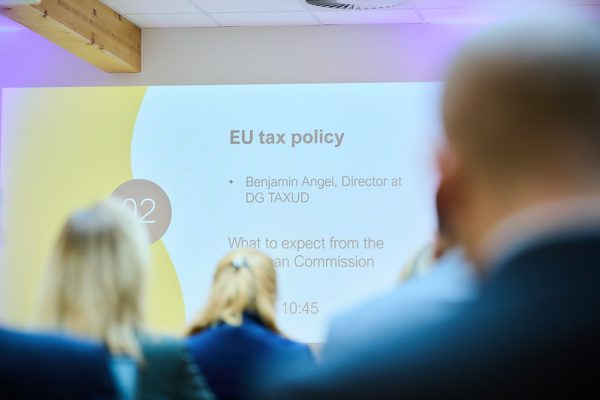
The EP’s FISC Committee held a public hearing Single Market tax obstacles, focusing on simplification, competitiveness and the limits of current EU tax coordination. The hearing brought together a panel of experts, including EC DG TAXUD’s tax Director Benjamin Angel.
Broad support emerged during the hearing for simplification and decluttering of EU tax rules. Certain speakers emphasised abolishing or scaling back measures rather than incremental technical refinement. Speakers moreover repeatedly identified lack of trust between Member States as a core barrier, constraining both binding harmonisation and voluntary soft-law cooperation.
Angel announced that the EC’s tax simplification proposals will be published in June. This package of measures involves revisiting 15 existing Directives, He said it would include a recast of the Directive on Administrative Cooperation (DAC) with a systematic review of reporting obligations, and a review of several pieces of legislation such as the Anti-Tax Avoidance Directives (ATAD 1 and 2), the Parent-Subsidiary Directive, the Interest and Royalties Directive, and the Dispute resolution mechanisms. A specific focus would also be on Pillar 2 companies.
Angel also referred to the upcoming 28th regime proposal (currently expected for 18 March), which will focus on company law but contain only very limited tax elements. He explained that this is because the EC’s BEFIT proposal is still on the table, and the EC does not want to duplicate efforts. The only concrete tax element included in the 28th regime would concern the deferral of taxation on stock options, which was intended to support start-ups.
MEP Matthias Ecke (S&D/Germany) drafted a report for a coherent tax framework for the EU financial sector to address fragmentation and boost competitiveness. It argues that the longstanding VAT exemption on financial services, originating in 1977, is outdated, distorts markets, and increases compliance costs, especially given technological advances and the rise of fintech.
The report criticises the patchwork of national tax measures (e.g., financial transaction taxes, bank levies, windfall taxes) for creating legal uncertainty, barriers to cross-border activity and opportunities for tax arbitrage.
The draft report also regrets the EC’s withdrawal of a previous EU-wide financial transaction tax (FTT), urging instead coordinated EU tax rules that reduce fragmentation, strengthen the Single Market and mobilise revenue for investment.
Ecke’s key recommendations include modernising VAT treatment for financial services, advancing EU-wide tax coordination where possible, and exploring coordinated temporary windfall taxes to ensure the sector contributes fairly without undermining financial stability.
As a next step, ECON Committee will need to vote on the draft report, and a subsequent final vote in Plenary is currently scheduled for 15 June.
Commissioner Wopke Hoekstra joined MEPs during a public hearing on the EC tax work, where MEPs expressed frustration over last year’s withdrawal of several tax proposals including DEBRA, Unshell, FTT and transfer pricing (see October 2025 tax policy update).
Hoekstra called these withdrawals pragmatic, since the proposals lacked realistic prospect of Council adoption. Instead, he indicated that he has asked EC services to assess the feasibility of using enhanced cooperation (group of willing Member States adopt/implement a proposal; opponents opt out) for DEBRA and similar proposals in the future.
Other highlights from the hearing: an EC study on financial sector taxation should arrive in the first half of 2026. The study will provide a holistic overview of the strongest options. The Commissioner also warned against unilateral EU action on Pillar 1 and digital taxation, emphasising his willingness to “exhaust all options” for a multilateral solution first.
On the 28th regime (see article above), Hoekstra indicated including only minimal tax elements into it to secure Member ‘support in the Council.
He also considers including Unshell proposal’s elements into the upcoming DAC recast initiative.
Cyprus circulated a document for EU Member State representatives in the Working Party on Tax Questions (High Level). It contains a summary of the EC’s evaluation report of DAC, covering the period 2018–2023.
The EC’s evaluation finds that the DAC framework has effectively enhanced Member States’ ability to combat tax fraud, evasion and avoidance by facilitating timely information exchange and aligning with other EU and international standards. It also emphasises DAC’s EU added value in harmonising tax cooperation and reducing inefficiencies.
Yet, challenges persist: increased legal complexity from frequent amendments, inconsistent penalties across Member States, issues in identifying taxpayers in certain exchanges, variable use of exchanged data, and costly IT systems.
Proposed improvements include simplifying the DAC text, strengthening penalties, enhancing data reconciliation, and modernising IT infrastructure to boost interoperability.
The Presidency asks Member States’ views on whether they agree with the findings of the EC report, and to propose measures for improving the DAC framework.
On 19 March, Tax Foundation Europe is organising its “Europe conference and gala”, focusing on key questions such as how policymakers should balance geoeconomic pressures whilst maintaining European competitiveness, what role should the next Multiannual Financial Framework (MFF) play, and whether European tax policy needs a new direction.
Further details on the speakers and the programme are available on the event website, and registrations are now open.
European Commission
Report on the interim evaluation of the Fiscalis programme for cooperation in the field of taxation for 2021-2027
European Parliament
Briefing - Highs and lows: VAT rate-setting in the European Union
Tax Foundation
Recommendations to the European Commission: a framework for tax simplification
OECD
Manual on Effective Mutual Agreement Procedures (2026 Edition)
European Parliament
Briefing - Targeting VAT fraud: role of the reverse charge mechanism
Council
EU finance ministers to adopt amended EU list of non-cooperative jurisdictions